Imagine this: waking up early to get ready for school before the sun even rises. You’re half awake and you are now in class by 7:20 am, expected to be paying attention without daydreaming about going back to sleep in your comfortable bed. For many students here at Renton High School, this is reality, but why should we keep it this way?
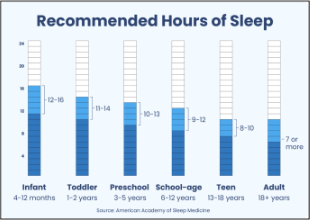
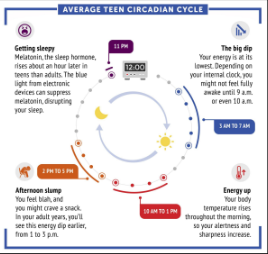
Getting good sleep is essential to feeling energized since it helps your body recharge and heal after each day. For most, 8 to 10 hours of sleep is the ideal amount to be getting each night, as stated by many sleep doctors. Yet these hours aren’t always being met for high school students. Pediatricians from the American Academy of Pediatrics (AAP) have stated that schools should start no earlier than 8:30 am to better provide time for quality sleep. This time also better aligns with the sleep rhythms, or circadian rhythm, of adolescents. These sleep rhythms are an internal clock that your body uses to respond to light and darkness to regulate hormones and, essentially, your sleep patterns.
During puberty, your circadian system naturally delays to a later time, which makes it so your body is physically unable to wind down and fall asleep, and this cannot be helped. Delaying school start times would realign students to a better learning window and improve their academic performance.
Data observed by the American Academy of Sleep Medicine (AASM) has also shown that students whose school started later had:
● Longer sleep durations, allowing students to get some extra z’s or use more time to catch up on missing assignments.
● Less negative moods, which helps to improve mental health and keep students happier.
● Better behavioral/physical health, getting them to feel more energized and attentive.
● More engagement during class time with the help of being better rested.
● Less first-period tardies and absences.
● Less depressive symptoms.
● And more.
Students’ health has been improved significantly by having later start times. With so much on the plate of adolescents in school, the stress that comes with it causes physical and mental fatigue and makes it harder to fall asleep, so providing more time to get rest will help students carry their loads with more energy. According to NPR news, evidence shows that the lack of sleep students receive can cause chronic sleep deprivation, which puts teens at risk for physical and mental health problems.
Interestingly enough, Seattle School District has delayed their start times for middle and high school students from 7:50 am to 8:45 am during the 2016- 2017 school year. Researchers from the University of Washington studied the changes between these students and found that they had an average of 34 more minutes of sleep, with total amounts of sleep at night being from 6 hours and 50 minutes to 7 hours and 24 minutes. They also found that later school times have shown a decrease in tardies and absences.
While initiating these changes might be a hassle, considering things such as bus routes that will have to be rescheduled, it is still worth a shot to help students be the best they can be, both academically and mentally. Complaints about being tired may never be a missing discussion amongst students, but the benefits of delaying school start times are sure to help students who wish they could sleep in like they do on Fridays. Sleep is just as important as doing well in school, so we should allow teens to rest as much as possible to set them up for the best in learning environments.

Sources:
– Walker, Tim. “Does School Start Too Early? | NEA.” Nea.org, 2025,
– Au, Rhoda, et al. “School Start Times for Adolescents.” Pediatrics, vol. 134, no. 3,
American Academy of Pediatrics (AAP), Sept. 2014
– “The Importance of Sleep during the Teen Years.” Baylor College of Medicine
– Schools. “Schools Shift as Evidence Mounts That Later Start Times Improve Teens’
Learning and Well-Being.”
– Kingshott, Ruth. “Argument for Later Middle School, High School Start Times.”
– Dunster, Gideon P., et al. “Sleepmore in Seattle: Later School Start Times Are
Associated with More Sleep and Better Performance in High School Students.” Science
Advances
– “How Much Sleep Do You Need?” Sleep Foundation, 9 Mar. 2021
– Neighmond, Patti. “Sleepless No More in Seattle — Later School Start Time Pays off for
Teens.” NPR, 12 Dec. 2018
– Picture specific sources:
– https://www.nigms.nih.gov/image-gallery/6611
– https://www.sleepfoundation.org/how-sleep-works/how-much-sleep-do-we-really-need
– https://www.pexels.com/photo/child-in-beige-hoodie-leaning-forward-on-table-feeling-
exhausted-while-studying-6958532/