Despite nearly a decade of Washington enforcing restrictions on driver data sharing as well as implementing new restrictions last year, ICE as well as other immigration enforcement agencies are still able to access this information to make arrests.
According to the Seattle Times, the University of Washington’s Human Rights Center reported that ICE agents were using a national computer system called Nlets, which gave them access to things such as driver’s data and criminal history all throughout the United States.
In Washington specifically, the agents go through a State Patrol platform called ACCESS, which acts as a “switch” to send information back to Nlets and requesting parties.
It is also mentioned that with the information they now have, they check the information with the Department Homeland of Security data for alleged immigration violations and use the data to verify or identify targets for arrests.
The Keep Washington Working Act is designed to bar state agencies from using Washington’s resources to help enforce civil immigration law. It was only mid-November of last year when ICE was cut off after Washington State Patrols noticed that ICE still had access to ACCESS, but the UW center pointed out that there were ways around this such as border patrol and other immigration enforcement agencies still using this system to gain information. So, ICE can still get this information, but they would have to reach out to these other agencies.
One recent case was with the arrest of Nelson Eduardo Piazo Sanchez. On November 4th, 2025, Sanchez was on his way to work when he was suddenly surrounded by ICE agent vehicles down by The Landing in Renton. After the arrest, his children were confused on how ICE knew their father and where he’d be. They strongly believe that someone had run their father’s license plate after hearing that the agents already knew their father’s name before he even rolled down his window, which is most likely the case.
King 5 mentions Angelina Godoy, the director of UW center for Human Rights, who brings up the reports made by the center that painted a rather worrying picture. “A significant percentage of the arrests we corroborated happened near places like Home Depot, Lowe’s, or Latino markets,” Godoy said. “It enables racial profiling when you go where you think a certain ethnicity congregates and then run the plates of everyone you see.” This is particularly concerning because ICE is targeting places and establishments frequented or believed to be frequented by people of color and running every license plate they see in the area, then making arrests when they find an immigration record.
The Seattle Times goes more in depth about the reports, bringing up U.S. Custom and Border Protection’s statement and how it doesn’t necessarily reveal the purpose data is sought and objected to suggestions in the UW report that state officials are actively participating in civil immigration enforcement. During a news conference, Godoy and other immigrant advocates stated that the state’s role in sharing driver’s license information is a betrayal of public trust and a violation of a 2019 state law that limits most forms of state cooperation with immigration enforcement.
The Department of Licensing and Washington State Patrol also issued a statement, claiming Washington has been taking aggressive steps to prevent immigration agencies from accessing driver’s data. In response to claims of violating the Keep Washington Working Act, they denied they were. “The Keep Washington Working Act does not prohibit information sharing for criminal law enforcement purposes,” the statement reads. Yet this begs the question; what would count as a crime? It’s been proven time and time again that immigrants are targeted for simply being an immigrant. So how would they monitor who gets this information?
The report from the UW center answers the question by revealing that the majority of cases documented in the article had their private information shared by ACCESS for civil immigration enforcement, not criminal law-enforcement. So despite denying claims, they still give immigration enforcement agencies information.
Nina Martinez, who is the Board President of the Latino Civic Alliance and one of the many nonprofit leaders who attended the news conference, talks about how scared people feel about this. “[People are] afraid to go renew their license, they’re afraid. They don’t understand, is it a camera? They can’t get their license, they feel afraid to go outside.”
It is a good view to bring up because now people are being pulled over for seemingly no reason, many of them wouldn’t know that ICE is actually finding and using their information to find and arrest them.
As ICE continues to make arrests with these resources, it can make one scared or unsure what to do, because ICE can still access our information even after they’ve been cut off via contacting other agencies.
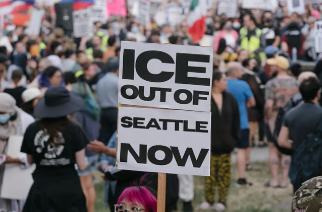
Continue to protest, spread awareness on social media, and urge our state government to crack down on ICE and completely deprive them of accessing our information. Our friends, peers, neighbors, and co-workers shouldn’t be arrested for being immigrants or not yet given the chance to get a Green Card. They are people, not criminals.
Sources:
Report: Federal immigration agents continued using Washington driver data through state-run system |
Immigration agents still access WA licensing data, UW report shows | The Seattle Times